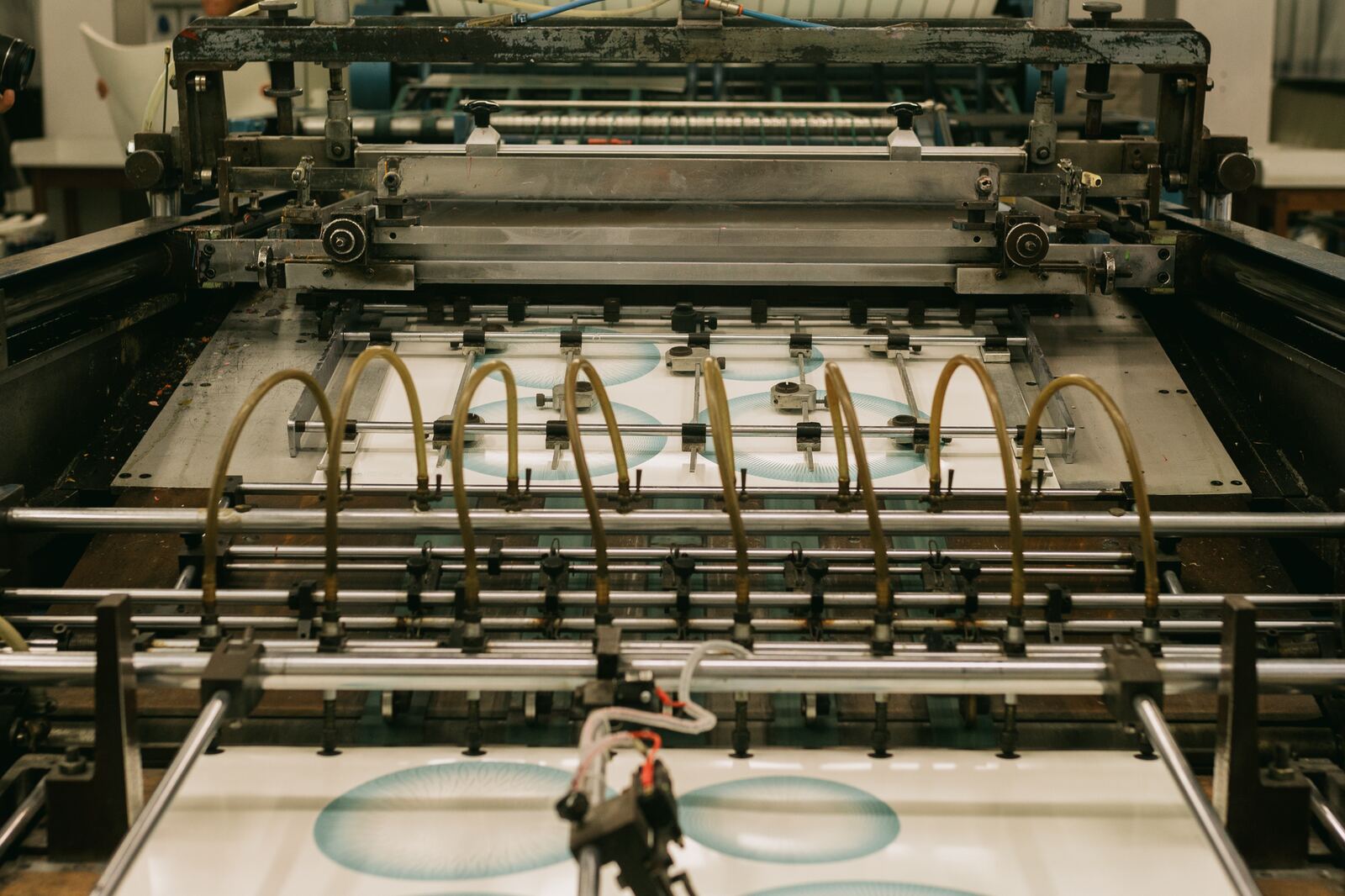
Every decorated garment order goes through the same path. Shops differ in how much of it is written down, and that difference shows up as jobs that quietly sit for a week.
The useful discipline is not naming the stages. It is defining, for each one, the single condition that lets a job leave it.
The nine stages
| Stage | Exit condition | Owner |
|---|---|---|
| 1. Enquiry | Requirement, quantity and target date captured | Counter |
| 2. Quote | Priced and sent | Counter |
| 3. Approval | Proof accepted in writing, with a timestamp | Customer |
| 4. Deposit | Payment terms satisfied or account approved | Office |
| 5. Blanks | Stock confirmed or purchase order raised | Office |
| 6. Artwork | Separations, digitised file or transfer sheet ready to run | Art |
| 7. Production | All pieces decorated | Floor |
| 8. QC and pack | Counted, checked, folded, boxed, labelled | Floor |
| 9. Dispatch and invoice | Shipped or collected, invoice issued | Office |
Written like this, two things become obvious. Stages 3 and 5 depend on someone outside your building. And every stage has exactly one owner, which is the only way a stalled job gets noticed.
Why exit conditions matter more than names
"In artwork" is a description. "Separations complete and saved to the order" is a condition. The first can be true for a week without anyone lying. The second cannot.
The test: could two people disagree about whether a job has left this stage? If yes, the condition is too vague.
The two stages that cost you weeks
Approval. The job is priced, wanted, and completely stationary. The only fix is an automated chase on a schedule plus one visible list of everything awaiting a customer. See cutting artwork approval time for the mechanics.
Blanks. A confirmed order with unconfirmed stock is a promise you have not checked. Confirm availability at quote time for anything unusual, and raise the purchase order the moment the deposit lands, not the morning you plan to print.
Where quality control belongs
Not at the end. A count and a check at the start of production catches short-shipped blanks before you decorate 46 of the 50 pieces you were sent. Then a second check at pack. Two cheap checks beat one expensive one; see the QC checklist.
Make the current stage visible without asking
The reason to run stages at all is that anyone can see where every job is without interrupting anyone. That means one board, visible to the whole shop, that is a byproduct of doing the work rather than something someone updates.
Printer's Friend models these stages directly: the production board for the office, the floor board for a shop TV, and per-role operator screens filtered to the stages each station owns. Artwork approvals are timestamped in the customer portal, so stage 3 stops being a text message you have to go looking for.
Time each stage, then argue about the right one
A stage list is a map. Stage timings are the traffic report, and they are what tell you which part of your process is actually the problem.
| Stage | Target | What a breach usually means |
|---|---|---|
| Enquiry to quote | 1 working day | Quoting is a bottleneck at one desk |
| Quote to approval | 3 working days | Chasing is manual and inconsistent |
| Approval to blanks ordered | Same day | Nobody owns purchasing |
| Blanks ordered to received | Supplier lead time plus 1 | Supplier choice, or no reorder point |
| Artwork prepared | 1 working day | Files arrive unusable, no art fee |
| Production | Published lead time | Sequencing, not capacity |
| QC and pack | Same day as production | Pack bench doubling as staging |
| Dispatch and invoice | Same day | Invoicing waits on a human |
The useful discipline is to review breaches weekly rather than agonising over averages. Three jobs that blew the approval target for the same reason is a process fix; one job that blew it because a customer was on holiday is life.
Where the hours really go
Ask any shop owner which stage consumes the most labour and most will say production. Measured, the answer is frequently artwork preparation plus the admin of chasing approvals, particularly in shops taking customer-supplied files.
You only find that out by recording it. If staff clock on to a job with the stage attached, the job costing report shows hours by job and the labour-heavy jobs ranked, and the pattern across a month tells you which stage to invest in. Adding a second press when your bottleneck is artwork preparation is an expensive way to make the queue longer.
Automate the handoffs, not the work
Every stage boundary is a place where a job waits for a human to notice something. Those are the cheapest wins in the whole process:
- Quote sent triggers a chase sequence if there is no answer in three days.
- Approval received creates the production job and flags blanks to order in one action.
- Blanks received moves the job to the print queue automatically.
- Production complete puts it in the QC queue rather than on a shelf.
- Dispatch raises the invoice and sends the tracking number without anybody typing.
None of that speeds up printing. All of it removes waiting, which is where lead time actually accumulates: in most shops, more than half of a job's elapsed life is spent waiting for a person, not for a machine.
Make stage changes cheap to record
If recording a stage change takes more than a couple of seconds, it will not happen on a busy day, and a stage list nobody updates is worse than no stage list because it lies to everyone reading it. A barcode on the work order and a scan station on the floor is the version that survives contact with a rush week: scan, stage advances, history recorded, customer notified. The floor board then shows the truth rather than the last time somebody remembered to update a spreadsheet.
Once the stages are honest, you can measure them. Print shop KPIs covers which of those numbers actually predict a good month.