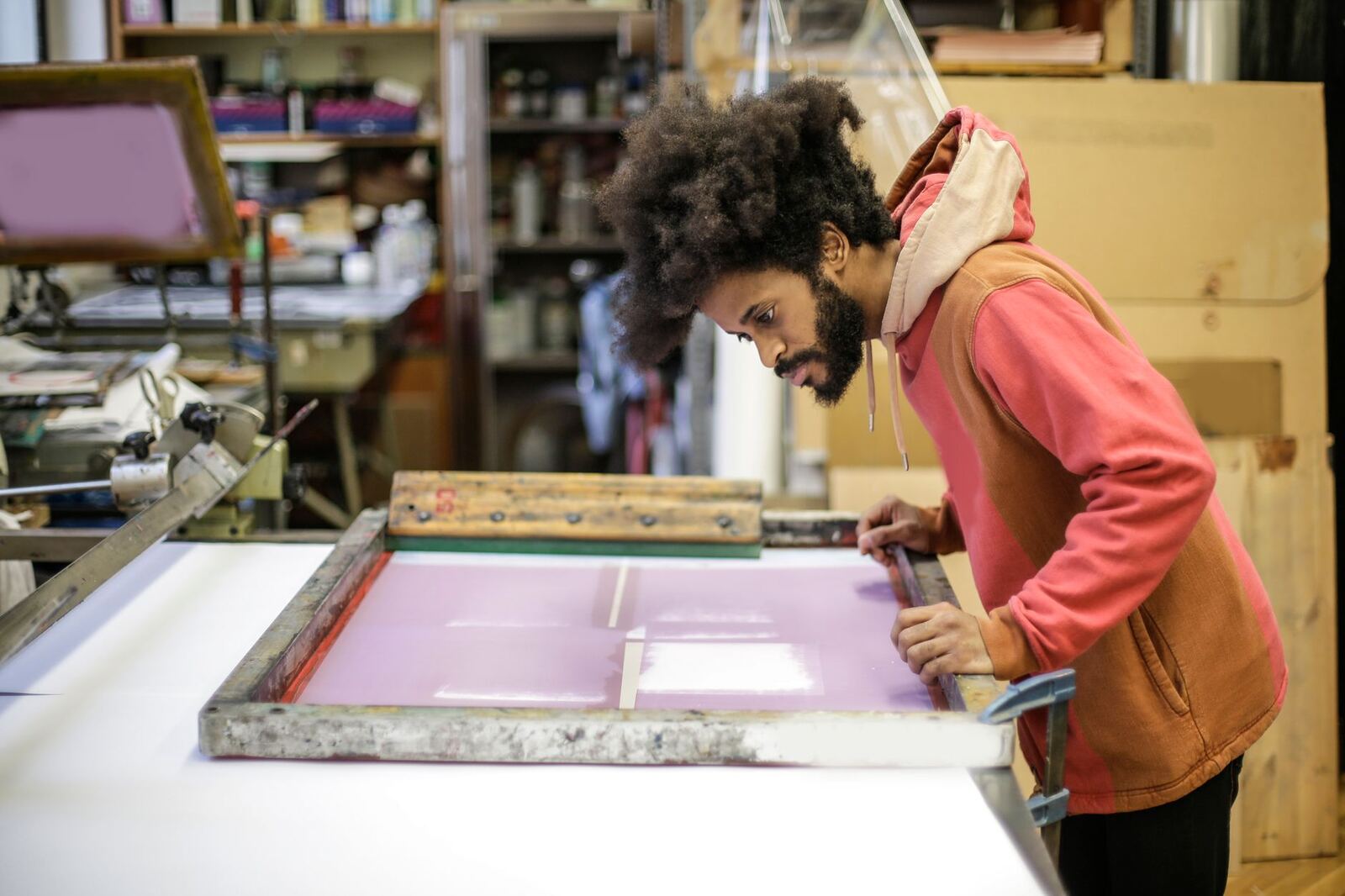
A print shop is a physical process, and every metre a garment travels is money. In a two-press shop the layout decides the throughput ceiling more than the presses do.
Lay it out along the flow
The garment's path is a straight line, so the room should be too:
Blanks in -> Staging -> Press -> Dryer -> QC -> Pack -> Dispatch
No step should hand work backwards. If your QC bench is on the other side of the room from the dryer, every job crosses the floor twice, past every other job in progress, which is how pieces get mixed.
Zones and what they need
| Zone | Needs | Common mistake |
|---|---|---|
| Blanks in | Door access, space to open and count cartons | Counting in a gangway |
| Staging | A pallet or trolley per live job, labelled | No dedicated space at all |
| Press | Clear working radius, ink and tools within reach | Ink stored across the room |
| Screen room | Adjacent to presses, dark, wet-safe | Reclaim next to the press |
| Dryer | Ventilation, reachable from both presses | One dryer, one press's side |
| QC and pack | Good light, bench height, bin for seconds | Poor lighting |
| Dispatch | Carrier access, space to stage boxes | Boxes in the pack area |
Good light at QC is not a detail. Most missed faults are missed because nobody could see them.
Give every job a physical home
One trolley, pallet or shelf per live job, labelled with the order number. Nothing on the floor, nothing in an unlabelled pile.
This single change usually does more for a shop's error rate than any equipment purchase. Mixed jobs, lost pieces and printing the wrong garment all come from work in progress with no address.
Keep wet away from screens
Reclaim, washout and coating generate humidity and dust. Both are enemies of exposure quality and of ink. Put them at the far end from the presses, with their own ventilation, and keep the coating and drying cabinet somewhere genuinely dust-free.
Cap work in progress deliberately
If you only have space for six live jobs at the staging area, that is your work-in-progress limit, and it is a useful one. A shop that starts twelve jobs to look busy finishes them slower than a shop that starts six and completes them. The physical constraint enforces the discipline for you.
Put the board where the work is
The layout's job is to make the next action obvious without anyone asking. A screen on the wall showing what is due, what is on the press and what is waiting on QC does the same job for time that the layout does for space. See the production board on a shop TV for what to display and where to mount it.
Measure the layout in handling touches
A layout is good or bad in one dimension that matters: how many times a human picks something up. Count the touches on a normal 100-piece job, from blanks arriving to the box going out.
| Step | Touches in a bad layout | Touches in a good one |
|---|---|---|
| Blanks in and put away | 3 | 1 |
| Pull for the job | 3 | 1 |
| Stage at press | 2 | 1 |
| Press and dryer | 2 | 2 |
| QC | 2 | 1 |
| Pack | 3 | 2 |
| Dispatch | 2 | 1 |
Seventeen touches against nine. At forty seconds a touch, on a hundred-piece job, that is a difference of over an hour of pure handling on one job. Nothing about it appears on a quote, and it is the same hour every time that job repeats.
Put the labour cost on the floor plan
Handling is labour, and labour is measurable. If staff clock on to jobs at the station where they work, you can see how much of your labour bill goes to production and how much goes to moving things around. The job costing report shows labour cost per job and margin after labour; a shop with good throughput on paper and thin margins after labour almost always has a layout problem rather than a pricing one.
A useful before-and-after: measure labour hours per hundred garments for a month, move one thing, measure again. Moving the pack bench next to the dryer is a free change that frequently pays more than a new piece of equipment.
Sizing the zones
Rough allocations that work in a small unit, as a share of usable floor:
- Receiving and blank storage, 20 to 25 percent. Under-sizing this is what pushes boxes into walkways.
- Staging and pulled work, 10 percent. Physical homes per job, labelled.
- Press and dryer, 30 percent. Including the space to walk around both.
- Screen room and reclaim, 15 percent. Wet zone, away from film and emulsion storage.
- QC and pack, 15 percent. A bench you can actually inspect on, well lit.
- Dispatch, 5 to 10 percent. Near the door, not near the press.
The two failures that recur: no dedicated staging, so pulled blanks live on the floor beside the press, and a pack bench that becomes the general-purpose surface for everything, so packing stops when it is covered.
Signage, labels and the boring wins
A labelled shelf position for every blank line, a numbered staging bay per job, and a printed work order that travels with the garments. These cost almost nothing and remove the single most common floor question, which is where something is. If the work order carries a barcode, the same document doubles as the way a job advances a stage: scan at the station, and the board updates without anybody walking to a computer.
Printer's Friend gives each station its own filtered view, so the packer's screen shows QC and pack and nothing else, matching the physical zone they stand in. For the process the layout is serving, see the nine stages.